Thursday, February 3, 2011

THE TITANIC AND THE ICEBERG

I am not referring to the rose varieties, but I do want to talk about roses. Specifically about two really great rose farms, whose names I will not include here out of respect for their vulnerability in a very difficult set of circumstances, and because we have been partners for many years, who have actually had no production of roses for Valentine's Day. I am not suggesting that they are low in production, I mean that after the best laid plans were drawn up and implemented, just as in years past, the net result is actually a productivity that is lower than that of a normal week!
If I had not been in Ecuador to witness the plantations first hand, I would have been incredulous and would not be willing to believe that the farms in question have no flowers to fill their pre-orders for this year's holiday. I would have suspected that they were diverted for more money or given to other customers.
Actually, to be in Ecuador in this case is an advantage because not only can I see the fields filled with blooms that are nowhere near ready for harvest, but I can see that the crew in the post-harvest is just the normal complement of people for a day in August, say, and the coolers have just a few measly buckets barely filled with roses.
But more than that, I get to see the pain in the eyes of the owners and their managers, because more than anything for these particular farms their word is theri bond, and desire above all to fill the orders, and with the quality we expect year round. And of course, this being Valentine's Day, the financial losses are considerable and also debilitating.
The farms are year round suppliers for Mayesh, and have really fabulous products, flowers that are aesthetically pleasing as well as being grown to the highest quality standards, and who focus on new and unusual varieties. 
At first we were incredulous - "This is a joke, right?" were the words of our rose buyer; then angry, then dumbfounded and now we are partners in their loss. But if I had not been here to actually see this disaster I could not have digested the idea of no roses at Valentine's Day. It simply would not be credible.
But just as the Titanic was deemed unsinkable, andwhen it did sink the first people notified did not believe it; the fact that this could happen to a farm is beyond the pale; but it has happened. Believing is seeing!


Fortunately, Mayesh's rose buyer has had to be very flexible, as the situation is very unusual and flowers are tight, and has adjsut to the problems that continue to spring up. However, he was able to replace most of these roses from other farms, and we are sending out a full shipment of 500 full boxes tonight. Of course, we will miss the familiarity and quality of our partners' roses, but the event is yet another reminder that we deal with wonderful manifestations of creation which are persihable and subject to the vagaries of nature.


Image - Wild roses growing on a bank near Latacunga, province of Cotopaxi, Ecuador.

Wednesday, February 2, 2011

EVERYTHING YOU WANTED TO KNOW ABOUT VALENTINE'S 2011 BUT WERE AFRAID TO ASK

Tomorrow is the first principal shipping day for Mayesh's Valentine's roses. They will fly out tomorrow morning on UPS and will arrive in Miami Thursday afternoon. By the time they have cleared customs and been inspected by USDA, the flowers will be picked up by Mayesh personnel in the wee hours of Friday morning. Thence they will be dispatched to various Mayesh locations around the country with the main load going by truck to Los Angeles. Thanks to prudent planning, judicious selection of transportation partners and associates in key locations in the supply chain, including myself being in Ecuador, Mayesh expects to have a good supply of qulaity Ecuadorian roses for its customers. But overall it seems there will be a dramatic shortage.
What has happened in Quito over the last three days or so is tantamount to a perfect storm that has, in fact, been about three months in the making.
What we would normally expect for Valentine's in Ecuador and Colombia simply has not come to pass, and unless our industry practices change radically, will not occur again for some years. Most of problems can be directly ascribed to economic factors. Underpinning the shortage of flowers for Valentine's Day 2011 is a resolution by many growers not too pinch their rose plants as they have a steady business all year long. They are trading risky plant manipulation and recurring peaks with corresponding low prices for weekly stability and a healthier, more predictable crop. Less stress on the planst and less stress on the personnel. From a long term perspective it is better for everyone.
The weather has been dreadful overall, and not conducive for the production of premium cut roses on plants that have been pinched, and even open production has  been compromised. The first 20 days was generally sunny in the south, so the farms in that zone were helped somewhat.
Another factor is that the new red roses such as Freedom and Forever Young do not perform when they are pinched in the way that Classy and Charlotte used to. These two old school reds would flush in a dramatic peak over ten days. The new reds that are now so popular produce yields that are more like a wave with no significant peak and in this cold weather the buds will not mature, lengthening the wave even more and dissipating the intentions of the pinch.
What is further exacerbating the situation is the lack of aircraft to move the flowers that have arrived at the airport. Today Lan Chile has almost 10,000 full boxes in their coolers. Jammed to the ceiling! So saturated has their operation become that they are not accepting freight for tomorrow. They should resume normal operations by Friday.  So in a week when flowers are in high demand and their is not enough supply, this situation is like the proverbial straw that breaks the camels back.
However, airline companies like Lanchile are just as susceptible to the vagaries  of the economy, and events such as bad weather in other parts of the world that affects their ability to position airplanes where they are needed, as the growers of the flowers.
It is worth noting that Colombia, too, has significant transportation issues, amongst other things.
So, yes there are roses available but I suspect that demand in the USA will outstrip supply for the first time in about 25 years. In fact you may want to think about ordering some because as far as I can tell we are looking at a sell-out, something that last occurred when I was a twenty-something.
"Yes, we have no red roses, we have no red roses today!"
Which is another way of saying that there are roses available but did you place an order with your supplier?

Tuesday, February 1, 2011

ALSO SPRACH ZARUTHSTRA

Today I drove up to the area north of Quito where roses are grown to review the farms that are supplying Mayesh for the Valentine holiday. The zone is generally termed Cayambe/Tabacundo but also includes the pueblos of Tupigachi and Guachalla.
Driving through Tabacundo, I passed the T-junction known as the "Y de Tabacundo" where it seems the monolith featured in "2001: A Space Odyssey" was resonating ominously under a dark, cloudy sky. I could hear the opening staccato beats of the tympani from the opening sequence of "Also Sprach Zaruthstra" playing in my mind. It is almost as if this year's visit to Ecuador has undercurrents of classical semiology. but unlike the golden Caryatids that I saw yesterday, this neo-fascist slab of concrete was  foreboding in its blank, gray, useless presence.
This rose-growing area, in contrast with the southern rose-growing region, it turns out has had almost no sun for two months. Continuous cloud cover such has this severely impacts the productivity of the rose plants, and all the farms that I visited have been impacted to a greater or lesser extent. For Mayesh customers it will be a relief to know that the rose buyer, whether by luck, detailed planning, coincidence or probably a bit of all three, had elected to make most of the bookings with farms in the south. Nonetheless we have some important suppliers in the north and it seems that there will be no extras over and above the pre-books this year.
I walked through greenhouse after greenhouse with thousands of plants burgeoning with buds but unfortunately many of them will not bloom in time for the Valentine's harvest. It is almost a cruel heartless joke that nature is playing with these growers, as the productivity of the plants seems to be lower than normal, even though they have taken every measure to increase production. 
BOOM, boom, BOOM, boom, BOOM, boom...BOOM....boom...

Clearly, as you can see in these photographs taken at Florecal, one of the top farms in Ecuador,  there is production, but just not the overabundance that we have become accustomed to. Part of the reason, in my opinion, is that growers are not pinching back the plants like they used to do so any hiccup in the weather erases any gains that may have been reaped from marginal cleaning of the plants. The main reason there is less incentive to pinch for Valentine's is that many growers now have a sustainable year round business that is profitable, and manipulating the plants for higher yields at holidays is deleterious to this stability. I believe that this is better for our business in the long run as the roses maintain a higher quality due to less stress on the plants. However looking myopically at the short term, as we are wont to do, and with Valentine's Day looming large, it is rather annoying.

Another significant problem casting a pall over an already tight market is the service of Lan-Chile airlines, who had a backlog of some 3,000 full boxes sequestered at the airport with no aircraft to move them, which has swelled to some 4,000 today, and the forecast is that it will take at lest until Thursday to work through the backlog. This is also choking the coolers at the airport and bringing one of the companies licensed and bonded to make the pallets that go into the cargo aircraft to a complete halt by saturating that companies coolers. While Mayesh only uses UPS, it is important to highlight the circumstances that exist in the industry at present. This is certainly a scandal, especially given the tight market conditions that exist here, and I imagine a review of the incident must occur after Valentines, especially as the trade organisation of Ecuadorian floriculture, "Expoflores" has already demanded a review of the problem from the Minister of Transportation.


Some notes on the photographs.
Images 2 - 6 courtesy Florecal. Their post harvest is incredibly well organised, and most of what they do is neither new nor original, but  it is the consistent application of many disciplines with a view to facilitating the labor that allows for focus on the final product; a premium rose.
Image # 2 - view of the post-harvest hall with grading racks
Image # 3 - roses being prepared fro grading
Image # 4 - Close-up of the grading rack. This system allows easy visual selection of homogeneous cutting points. First instituted at Flores de Napoli c. 2005
Image # 5 - Preparing the bunch
Image # 6 - Another bunch being prepared,; note the mirror that allows the packer to see the disposition of the flower heads, without having to peer at the bunch.


Monday, January 31, 2011

FROM NERO TO HERO

Today is day one of my ten day sojourn in Ecuador checking roses for the 2011 Valentine's holiday.
Whilst driving to visit one of the farms I espied this stunning monument to conspicuous consumption at its most visceral. These two golden caryatids sparkled in the sun of a late January afternoon, perhaps a reminder that the rose growers may need to sacrifice their first born in order for the Sun-Gods to be satisfied.
They also reminded me of Rome, and the legend of St. Valentine, who defied a decree from Caesar that prohibited matrimonial services for Christian youth, and joined many young lovers in secret nuptial ceremonies. Beatified by the Roman Catholic church, it was the Victorians who re-invented the St. Valentine concept into the idea of sending amorous cards anonymously to loved ones. This was soon transformed into a flower holiday, which is far more romantic, and the reason why I am in Ecuador.
Most of Ecuador's roses are grown to the north of the capital city of Quito in an area dominated by the towns of Cayambe and Tabacundo; and in the south in an area that is known as Cotopaxi, but which stretches over almost 80 kms from Pastocalle to Ambato. My first day was spent visiting the farms in the south that will be supplying Mayesh Wholesale for this holiday and while I have heard many reports of a harvest coming late, for the most part what I saw in the fields and in the post-harvest was substantially good news for wholesalers and retail florists who buy later than the supermarkets.
As you can see in the pictures there are roses, red roses, in this case "Hearts", waiting to be harvested but this may not be the case everywhere.
There is a good chance that this year's rose harvest appears to be on target to hit a tiny window shipping out of Ecuador almost perfectly. However, I need to reserve judgement until tomorrow when I will get the overview of the farms in the north.

Wednesday, January 26, 2011

COUNTDOWN TO VALENTINE'S DAY 2011

As we approach one of our largest flower holidays, and certainly the most significant as far as roses are concerned, there has been quite a bit of speculation on the quantity and quality of the rose harvest for Valentine's Day 2011. At this point it is still a point of conjecture as only the very first blooms have been harvested for Valentine's Day, and they have not made there way to our shores quite yet. Incredible, even sad, but true! Many of the mass-markets' roses need to get into the logistical pipeline by the 28th of January in order to make their way through their distribution chains to their outlets. 
Mayesh Wholesale, in a concerted effort to assure delivery of appropriate quantities of roses and a commensurate high level of quality  in accordance with the rose buyer's orders, has put a body on the ground in Ecuador for the past 15 years. You guessed it, yours truly is that person, responsible for oversight of rose quality, timely delivery by the farms and programmed daily dispatch by the airline from Quito, Ecuador, to Miami.
As I wrote in December on this blog, it would appear that there will be very large variance in quality from farm to farm, with a lot of product being compromised by disease due to a combination of bad weather and fungal attacks on the plants. As I have said many times before, it will be prudent to obtain assurances from your supplier(s) on the provenance of the roses they will be procuring for you.
All speculation aside, I shall start visiting the farms that will be supplying Mayesh this year for Valentine's Day on Monday 31st of January, reviewing the quality of the respective rose harvests, and ascertaining that the suppliers will be able to fulfill the orders. After a couple of days I will be able to ascertain the quality of roses Mayesh has ordered, as well as the overall situation in Ecuador, and will continue to monitor every aspect of the rose supply as the shipments reach their peak volumes around the first weekend in February, and continuing through until 9th of February.
Starting on February 1st, watch this space for daily updates, weather information, airline issues and just about anything related to the rose harvest in Ecuador for Valentine's Day 2011. Here we go...

Tuesday, January 25, 2011

TROPICAL HYDRANGEAS


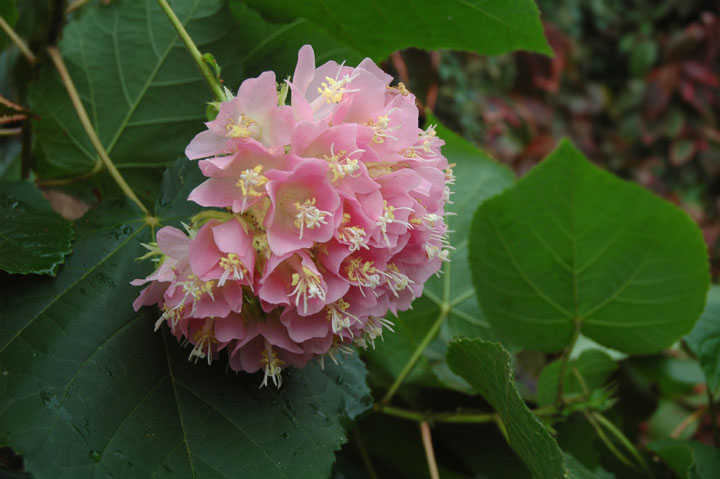
In February, after Valentine's Day my fiancee and I shall be commencing work on a small flower farm. Out intention is to grow novelty products for the cut flower industry. We are selecting plants based on their suitability to the climate in South Florida which tends to be hot and humid, and is classified by USDA as Zones 9-11. The group of ornamental flowers and berries that we have chosen is a mixture of South Florida natives and plants from around the world that thrive in hot weather. Most are tried and true, but others are completely unfamiliar but are entirely fascinating. As such, one that turned out to be a rather miserable failure as a cut flower but which is entirely enchanting is the so-called "Tropical Hydrangea". The name alone drew me to the flower as a moth to a lamp, and this year we finally got some flowers on the trial shrubs. They really are spectacular, but are quite short-lived as flower. They have a rather sickeningly sweet aroma, like cake icing, and produce copious amounts of nectar to which bees are attracted to in great numbers. Certainly, if pollination is required, this plant is a must for any farm, and we intend to plant several around our farm for this reason as well as for the aesthetic appeal of the shrub. In December and January masses of bright pink balls hang from the branches, and so profuse is the flower-set that the boughs bend down. From a distance the flowers look like hydrangeas hanging upside down from the bushes, although closer inspection reveals the florets are like those of a rhododendron although configured like a hydrangea.
Dombeya wallichi is the scientific name for this attractive plant and is named after a certain Josephe Dombey, a noted French botanist and plant collector, but who seemed cursed with bad fortune.
His outstanding exploration, cataloguing and collecting of new species all form important parts of botanical collections in the British Museum, The Royal Garden Collection in Madrid and the Museum of Natural History in Paris. In 1778 the French government sent him to Peru, where he amassed a significant herbarium. In 1780 he sent the collection back to France, but the ship carrying his cargo was captured by the British, who kept the collection, despite overtures from the French government that continue to this day. Josephe Dombey was able to assemble another collection containing some 300 specimens but when it was prepared for shipping the Spanish authorities confiscated it on grounds that indigenous specimens were not permitted export to foreign countries. This collection was subsequently sent to Spain where it formed the basis for a florilegium of "La Flora Peruana" produced for the Spanish Crown by noted Spanish botanists Pavon and Ruiz. As if that was not bad enough, he proceeded to Chile in 1782 where he assembled an outstanding collection of Chilean flora, but on his return to Europe he landed in Cadiz, Spain in 1785 whereupon his collection was confiscated and he himself was imprisoned. Dombey was only able to secure his release after assuring authorities he would not compete with Pavon and Ruiz' work, and even then was only about half of his Chilean herbarium was returned to him.
Such was his reputation for thorough work that he was able to secure a stipend from the French government, and retired to practise medicine in Lyon.
This turned out to be also not fortuitous as Lyon was a hotbed of the revolutionary resistance, and Dombey found many of his patients being removed from his practice and dispatched to the guillotine during the French Revolution. With the assistance of friends within the "Committee for Public Safety" Dombey, was given an important diplomatic mission to introduce the new Metric system to the US congress, with the sponsorship of many luminaries including Thomas Jefferson. He set sail for North America in 1794, yet the same bad fortune that plagued his entire professional life struck again, and even as the prospect of Philadelphia was on the horizon, a sudden violent storm swept the brig he was on down to the Caribbean where Dombey made landfall on the island of Guadeloupe. The governor of the island was still loyal to the French crown and immediately imprisoned the poor doctor. However, many of the townsfolk who were supporters of the Revolution, upon learning a representative of the new French government had been imprisoned rose up and stormed the garrison, freeing Dombey. However, in the ensuing violence Dombey caught a fever and rapidly perished.
It is quite amazing that the USA came so close to adopting the metric system early in its history, especially when one considers the disaffection for all thing British was quite prevailing in the New World. Yet literally, the winds of history blew that opportunity away, and to this day we continue to use a ponderous sytem of measurement based on an English monarch's shoe size that has even been abandoned by Britain.

Friday, January 21, 2011

BLUE FAILS

This week the TPIE show was in full swing at the Broward Convention Center in Fort Lauderdale. In case you were wondering what T-Pie is, it turns out to be an acronym for Florida Tropical Industry Exhibition. I think. Something tropical anyway. It is actually an event that focuses on foliage plants for interior spaces, bedding plants, nursery centers, landscape plants and the fern industry. A couple of things were strikingly evident, namely that A.) succulents are becoming incredibly popular, which is a good thing, and that B.) the color blue continues to take hostages in the world of good taste, and this is a bad thing.
As featured in the Diary last year, the rather awful stem-dyed blue cymbidiums from Holland are enjoying a flurry of appreciation in some parts of the USA. But, as if that was not enough, a process to dye phaleonopsis plants with a rich blue color has been developed by some botanical miscreant in Holland. At the show a company called "The Silver Vase" was touting a new technology to which they had acquired exclusive rights that enabled them to dye actual rooted phaleonopsis plants. Unfortunately the result looked like something from my son's elementary school science fair, and would look right at home next to the bubbling volcano. And definitely a candidate for the Society for the Prevention of Cruelty to Flowers.
I do think that when the so-called arbiters of trends and taste advocate a certain color as being the flavor of the year, restraint should be practiced by the fashion faithful and extreme prejudice and judicious application of color should be considered when using natural materials.
On the other hand, another very popular color that is in vogue is gray, and this was well represented in various hues and tones from a glaucous green-gray through neutral, unsaturated gray to a purplish slate blue-gray in a segment that is enjoying quite a lot of momentum of late; which is that of the succulents. This rather loose, general term encompasses several genuses, notably Echeverria; Aeonium; Sempervivum; and Kalanchoe. They are extremely hardy and incredibly versatile and can be employed outdoors in landscaping, where they are particularly suitable for xeriscapes, and can also be used for interior decoration, in planters and pots. In the cut-flower industry succulents are gaining extensive exposure and are being used more and more by floral professionals for their unique color and decorative rosettes.
And if you don't like the color you can give them the Bornay treatment, of which I am also sceptical. But better than blue phals. Or is that Blue Fails?


Image #1 & #2 - Blue Phaleonopsis plants from The Silver Vase; TPIE
Image # 3 & #4 from TPIE show
Image #5 From Bornay Blog; entry January 11th 2011
Related Posts with Thumbnails